Rabbi Yonah Geller, Portland Oregon, Rabbi of Cong. Shaarei Torah
for 40 years points that there are at least THREE
times in our history where a small jug or small amount of
oil went a long way.
1)
Last
week in Parshas Vayishlach we read about Yaakov being left alone just before he
is accosted by and fights with an anonymous MAN throughout the night.
And Chazal are bothered: Why
was Yaakov by himself? He was travelling
with his whole family! And answers the
Gemara in Chullin (91a), quoted by Rashi and many others, that Yaakov had
accompanied his whole family across a river, but he had forgotten PACHIM
KETANIM, small jugs, and he went back to retrieve them himself, and it was then
that this ISH attacked him.
–
The Maharal
even points out that this was just a few jugs, something most
others would have just left behind, but Yaakov thought they were important
enough to go back for, important enough even to risk his personal safety.
2)
Haftara for Parshas Vayera, from Melachim
II, tells the story of a poor woman, Chazal tell us that her husband was the
navi Ovadia. And her husband had died,
and she tells Elisha the Navi that she has debt collectors coming to collect,
but she has NOTHING in her home except “ASUCH SHEMEN”, a jug of oil.
Elisha tells her not to worry.
Go grab as many containers as you can, close the door behind you in your
home, and keep pouring. She does so, and
she pours and pours the oil until the receptacles run out, and she now has
enough money to pay her debts. But even
as you read the story it’s clear that she regrets that she doesn’t have MORE
receptacles. As if she never could
have imagined how much oil would come from this small jug.
And, of course, the third example, the story of Chanukah: As the gemara in Shabbos Daf 21b asks:
מאי חנוכה?
What is Chanukah?
And the gemara goes on to describe what we call “the miracle of the
oil”. A small PACH SHEMEN, enough only
for one day, which lasts for eight.
The Marahal in his sefer Ner Mitzvah points out that the
Miracle of the oil in the BHMK was actually another manifestation of what had
already occurred on the battlefield:
–
In
the war of Chanukah, a small group, led by Kohanim, give it a shot to try
something extraordinary that would otherwise be totally UNEXPECTED, and they
succeed.
–
So,
too, in the BHMK, a small flask of oil, which otherwise would be expected to
have little impact, is lit by a group of Kohanim, and has an extraordinary
impact.
So, what, asks Rav Geller, is the tzad hashave, the common thread
that runs through each of these stories?
That in each story, there are people who look at something that otherwise
would be seen as small and insignificant, something that would NOT EVEN BE
WORTH PAYING ATTENTION TO, SIMPLY NOT WORTH THE EFFORT, and they say, you’re
not seeing straight. It may look small, but this PACH KATAN can have an EXTRAORDINARY
IMPACT.
And maybe even more important, people who may have seen themselves
as small, who were able to do something ENORMOUS.
Rav Yaakov Moshe Charlap: Could ask, why
do we light a Menorah in our homes? A
Non-Kohein would NEVER light the Menorah!?
And he explains that the fact that on Chanukah EVERY SINGLE JEW lights
their own menorah in their own home emphasizes the role of each of us play to
light a fire in the hearts of other Jews and in ourselves. We each light a Menorah to remind ourselves
of the beautiful light inside each of us that bring so much light to the world.
Rav Kook writes:
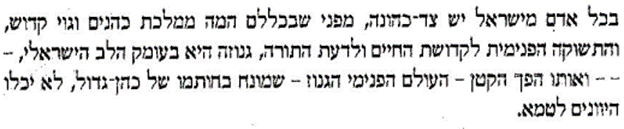
Within every Jew there is some element of being a Kohein, since we are all part of the “Nation of Priests and the Holy Nation”. And that inner desire for a life of holiness and to understand Torah is stored deep within every Jewish heart. And that same jug of oil – that inner hidden world – which has the seal of the High Priest, the Assyrian Greeks would never be able to defile.
As you well know by now, I returned one week ago from what I can
only describe as a confusing, horrifying, inspiring, and amazing trip to
Israel. I was in the country for 72
hours total. Yet, the time there had an
extraordinary impact on me. I shared many of the details in writing during that
week on WhatsApp as well as when I returned via an email that went out, but I
want to share three takeaways from the trip, though I could share so much more.
And really all three ideas I’m going to share, relate to this message
of realizing the power the PACH KATAN, that small jug inside of each of us, can
have on ourselves and on others:
1.
The ability for one, regular, person to do things they never could
have imagined:
On my last day in Israel, we went to visit individuals who had been
injured on October 7th and were recovering in Soroka Hosprial in
Beer Sheva. One of the young men I
met was Amiram Bitbol. Amiram is a police
officer in the middle of the country. When he heard what was happening down
south, he grabbed his gun and his gear and drove down to the kibbutzim to fight
off terrorists until he was critically injured. Together with a small group of
others who had come down to fight, he helped stave off the terrorists and keep
them from moving further into the state as we now know they had intended to do.
He didn’t go with a group. He went on his own. I mentioned in my
writings that someone asked him how he had the courage to DRIVE TOWARDS THE DANGER. He couldn’t even understand the question. He lost friends in the fighting, but he told
us: Ananchnu Am Echad. Achim Anachnu, and he was ready to go back to his work
as a police officer, protecting Am Yisrael.
Yesterday, I saw video that he left Soroka hospital on Erev Shabbos,
two months to the day since the attacks.
In Kibbutz Zikim, we met Elior, the head of the volunteer security
force, who, along with only 11 other volunteers, held off a group of 10 heavily
armed terrorists. They spent 4 hours
keeping them out of the kibbutz, saving the lives of 1,000 residents who live
there.
In Sderot, we met Rav Sassi, a rebbe at the Hesder Yeshiva of Sderot,
who, once he heard that terrorists were in Sderot, got in his ambulance and
took his gun, and drove towards the bullets, saving multiple people. Together with a few others, he held off 50
terrorists who ended up barricading themselves in the Sderot Police Station
(which was eventually bombed by the IAF), preventing them from making their way
up the hill where over 300 students were staying at the yeshiva for yom tov.
2.
The Impact ONE PERSON can have on so many…
Wherever we went, soldiers, families, were so appreciative that we
have come all the way from the United States just to be with them.
–
Mother
of Eitan Dov Rosensweig HY”D, whom we visited at their shiva, wanted to see
each of our nametags which had our cities on them, to see where we had all come
from.
–
No
matter where we were, when we offered letters from adults and children, the soldiers,
the bereaved families, they were not just making us feel good. They really wanted them!
–
Every
family member of a hostage that we spoke with, we asked if we could daven with
them for their son, and their response each time, was an enthusiastic yes! Some
of these people are very secular, and when greeted with a group of rabbis, they
were so appreciative.
–
Soldiers
BOTH at the hospital and at the BBQ we had later that night kept on asking: Did
you go to that rally with 300,000 Jews in Washington, D.C.!? That was AMAZING!
–
What
we are doing here MATTERS TO PEOPLE IN ISRAEL.
And they LOVE seeing American visitors.
It gives them so much strength!
3.
Connection to ALL JEWS, Connection to Eretz Yisrael & Medinate
Yisrael
One thing that I continued to feel after I came home, was how much MORE
connected to the land I feel after all of this.
BH I have had the zechus to go to Israel many times, but NEVER have
I had such warm, close conversations and experiences with non-religious Israelis. And on this trip, MOST of the time we were
speaking to individuals who were NOT religious AT ALL. Especially in the south, in the hospital, the
vast majority of the kibbutzim are totally not religious.
At one point in the hospital we were speaking with Amiram, and he
sat up and I saw this huge tattoo along his entire arm. And it was the first time during the whole
visit that I even REALIZED that I’m dati and he isn’t. Because for most of the trip it just didn’t
seem to matter. As Amiram said to ME, “ANACHNU
AM ECHAD!” We’re ONE PEOPLE. And it made me feel connected to EVEN MORE of
Am Yisrael and even MORE connected to Eretz Yisrael.
I have never been a fan of Aliyah-shaming, and I still am not. You know, well-intentioned people who have
made Aliyah and now critically ask Americans how they can still live in America. I don’t think it works. I actually think it has the OPPOSSITE effect. I don’t know ANYONE who has EVER made Aliyah
because they felt guilty. Nor do I
believe that we should make Aliyah out of fear for what’s happening here. We should make Aliyah because we feel drawn
to the Land of Israel, to the place where we belong, to the place that is the FUTURE
of our People.
And part of what I feel in that negative rhetoric sometimes, is
that I would feel annoyed when people would say “you’re not going back home. You already are home.”
With all that being said, when a number of people said to me this
week, so nicely,“Welcome home”, it was hard for me to hear. I, of course, was very happy to come home to reunite
with my family and the community that I love.
But it felt different this time. I felt that when I left to come back to
the United States, I wasn’t just leaving the land, I wasn’t just leaving my nuclear
family, my brother and his family. When I left this time, I felt I was
leaving my NATIONAL family behind too.
And maybe that’s because I felt more like family with EVERYONE in Eretz
Yisrael and Medinat Yisrael. Or maybe it’s because our family is hurting so
bad, or because our family is fighting so hard for all of us. But it felt different to leave this time than
any other time in my life, and I’m glad that it did.
If I have to sum it up, though, I would say that what I saw and
experienced in Medinat Yisrael was a people who are hurting terribly, but also
a people who are never going to stop fighting!
No matter how long this war takes, there will NEVER be a ceasefire
in the hearts of Am Yisrael. And just as
the Jews in Eretz Yisrael continue to stand up and fight another day, whether on
the battlefield or in how they live their daily lives. We, too, must continue
to fight to bring the light of our small pach shemen out to the very dark world
around us each and every day.
The language of the gemara in Shabbos is interesting when it talks
about that pach shemen. It says,
נעשה בו נס והדליקו ממנו שמונה ימים.
The simple reading is that there was a neis, a miracle, and it
STAYED LIT for eight days.
Perhaps we can read the gemara a little differently. Naaseh Bo Neis
V’Hidliku Mimenu. The people had been
beaten, and humiliated, and tortured, and yet when they returned to the Beis
HaMikdash and DIDN’T have enough oil they could have just given up.
But Naaseh Bo Neis, there was a miracle, HIDLIKU MIMENU. They didn’t say, “what’s that SMALL AMOUNT OF
OIL GOING TO DO ANYWAY! THE DARKNESS
WILL JUST RETURN TOMORROW NIGHT! The neis was that they were willing to get up
and LIGHT IT, with no promise that it would last. And what happened? HKBH saw our strength, and resolve, and
determination, and allowed to keep burning and burning.
Yehi Ratzon, that Hashem should see the incredible strength and
determination of our people, in Eretz Yisrael, right here in this room, and
around the world. May He see our
willingness to NEVER UNDERESTIMATE THE FIRE THAT CAN EMANATE FROM THAT PACH
SHEMEN INSIDE US, and may He respond by allowing that fire to burn forever and
ever, expelling the darkness outside with an incredibly powerful light.